
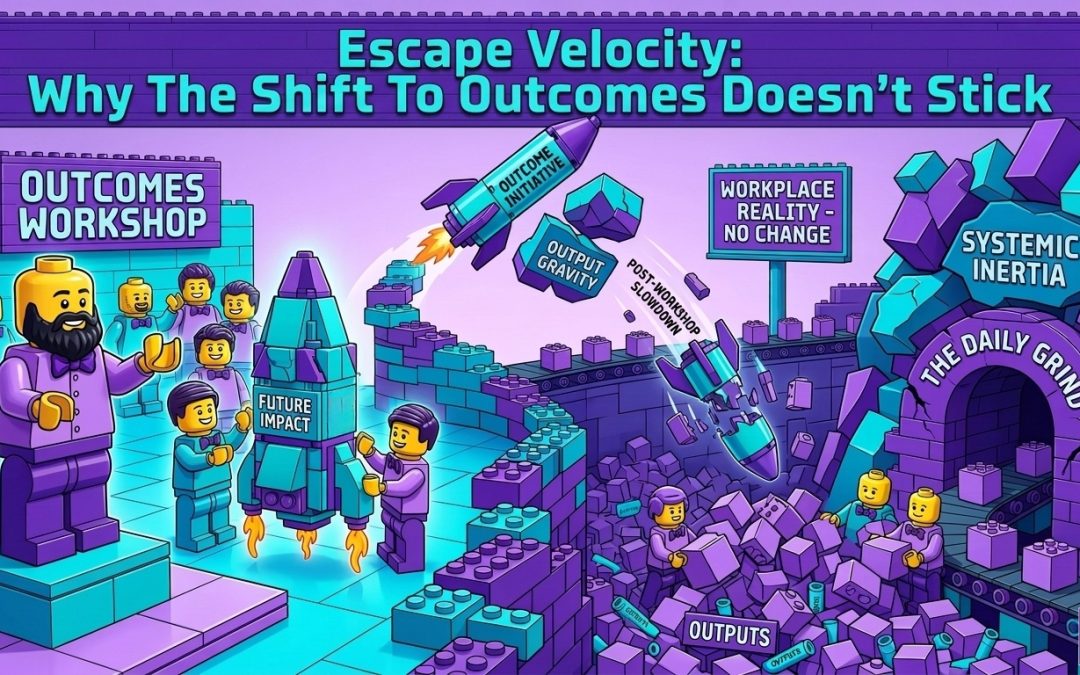
The sad reality is that the shift to outcomes fails to some extent in many teams and organisations. They decide and commit to the initial effort of making the switch, of taking this important leap. Maybe it’s through OKRs, maybe it’s another goal-setting framework, maybe it’s a broader strategic alignment effort. Whatever the vehicle, the destination is the same: stop defining success by what we ship and start defining it by the change we want to create for end users and the impact it indirectly generates for the company.
And at first, it works. You can see it happening. People start asking different questions in planning sessions. Conversations move beyond “what are we building?” toward “what are we trying to achieve?” or “what do we hope to change by doing this?”
The shift has started to manifest. And then, sometimes in a too subtle way, things start sliding back.
The Gravitational Pull of the Status Quo comes into play.
Without the right support structures, the existing system like the processes, the habits, the way work has always been discussed and decided – exerts a gravitational pull that drags everything back to where it was before. The roadmap goes back to more or less a to do list. The conversation is still around what was done only and not what has changed and the impact it had.
Escape velocity is not reached.
This is one of the most common pitfalls I encounter, and frankly it’s one of the most interesting challenges as a coach and trainer. It’s not that people don’t get it. They do. The workshop lands. The exercises click. The theory resonates. The problem isn’t comprehension – it’s persistence of both the changes and the support needed. The mental shift and new way of thinking about what they decide to work on simply doesn’t stick because the environment around it hasn’t changed enough to sustain it.
The Gap Between Understanding and Embedding
Thinking in outcomes immediately after theory, a workshop, and some practice? Doable. Most teams can get there. You can see the lightbulbs go on. Getting it to stick so it’s still there when you check in after one or two quarters? That’s the real challenge. That’s where the real work begins.
The difference between a team that “tried outcomes” and a team that actually thinks in outcomes is rarely about skill or intelligence. It’s about whether anyone paid attention to what needs to change in the system around the team so that outcome thinking becomes the new standard – the new status quo – rather than a brief experiment that fades under the weight of old habits.
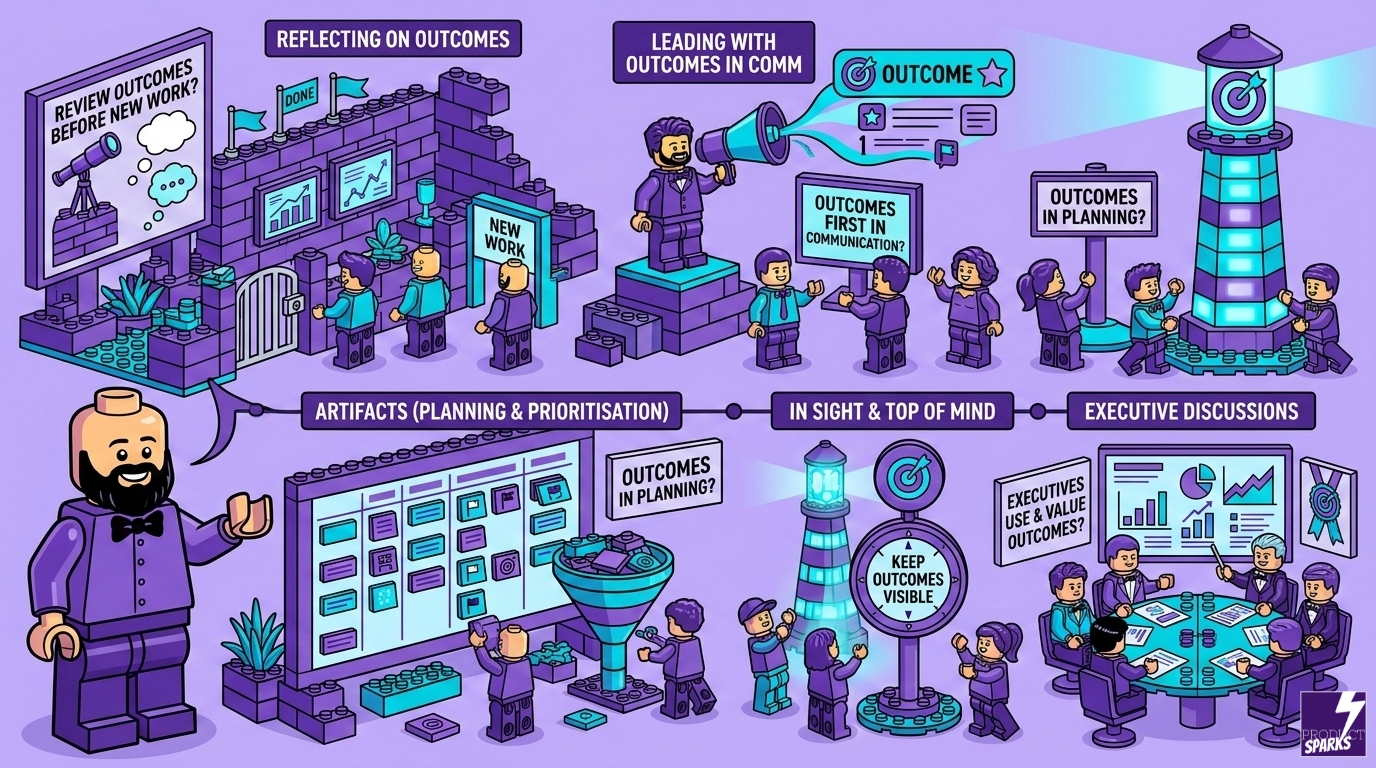
Five Questions to Check Whether the Shift Is Sticking
If you want to know whether your organisation is actually embedding outcome thinking – or just remembering a workshop – ask yourself these five questions:
1. Are teams reflecting on outcomes before taking in new work?
When planning kicks off – whether that’s sprint planning, quarterly planning, or anything in between – are people pausing to ask “what outcome are we trying to move?” before they pull in the next batch of tasks? If the outcomes aren’t shaping the intake of work, you’re not changing the status quo.
2. Are we leading with outcomes in our communication?
When someone explains what their team is working on, where do they start? Do they open with the outcome they’re pursuing and then describe the work they’re doing to get there? Or do they jump straight into tasks, features, and deliverables? Language is one of the clearest signals of whether thinking has genuinely shifted. If every update still starts with “we’re building X” instead of “we’re trying to achieve Y, and here’s how,” the old mental models are still running the show.
3. Are outcomes showing up in our planning and prioritisation artefacts?
Look at the actual tools your teams use day to day: the Jira boards, the Notion pages, the roadmap slides, the virtual whiteboards. Are the outcomes visible there? Are they referenced, linked to, and used as a lens for prioritisation and decision making? Or do they live in a separate document that nobody opens after the kickoff meeting? The artefacts teams work with every day are the ones that shape behaviour.
4. Are we actively keeping outcomes in sight and top of mind?
Outcomes that are set once and then filed away are outcomes in name only. Are they on the wall, literally or figuratively? Are they referenced in stand-ups, retros, and decision-making moments? Is there a deliberate rhythm that keeps bringing attention back to them? It doesn’t need to be heavy-handed, but it does need to be intentional. People are busy. The work in front of them is loud. Without deliberate effort to keep the outcomes visible and present, they fade into the background and the shift doesn’t stick.
5. Are executives and leaders using and valuing outcomes in their own discussions?
This one might be the most important. Teams will quickly learn what leadership actually values, regardless of what leadership says it values. Teams optimise for what their leads are measuring or pay attention to. If executives are still asking for feature timelines and delivery dates without connecting those conversations to outcomes, the signal is clear: output still matters more than impact. But when a leader opens a review by asking “how are we tracking against our outcomes?” or references the team’s outcome in a company-wide update, it sends a powerful message. It tells the entire organisation that this is how we think and what we care about now.
Making Outcomes the New Normal
None of these five questions are necesarily about whether people understand outcome thinking. They’re about whether the environment supports it. A workshop can change how people think. But only systemic change – in rituals, in artefacts, in language, in what leadership pays attention to – can make the shift to outcomes happen and that new thinking last. The goal isn’t just to introduce outcome thinking but to change the conditions so that outcome thinking becomes the path of least resistance rather than something that requires constant effort to maintain.
If you’ve gone through the effort of adopting OKRs or any outcome-based approach and you’re finding that the initial momentum has faded, it’s worth stepping back and honestly assessing where you are against those five questions. The answers will tell you whether you have a knowledge problem or an environment problem. In my experience, it’s usually the latter.
Need Help Making the Shift Stick?
If this resonates with where your team or organisation is right now – if the shift to outcomes started well but hasn’t quite taken hold or if you’re planning to switch to outcomes and want to make sure that they stick – I can help.
I work with teams and leadership to not only introduce outcome thinking and OKRs, but to embed it into the way work actually gets done: the planning, the communication, the prioritisation, and the leadership conversations that ultimately determine whether this sticks or fades.
Whether you’re just getting started with outcomes and OKRs or you’ve been at it for a while and need support closing the gap between understanding and embedding, let’s talk.
Reach out to start the conversation.